
|
Nancy Duncan, Au.D.
Missing the High Notes? The Truth About High-Frequency Hearing Loss
You may have noticed a growing challenge: You can hear that someone is speaking, but the words themselves seem to slip through your grasp. Conversations in bustling restaurants, meetings at work, or even the laughter of children can feel muffled, as if everyone around you has started to mumble.
This experience is not a reflection of your attention or focus; while you can hear sound, you’re not truly hearing the words being spoken. You are not alone in this, as many people experience the same subtle shift in their hearing.
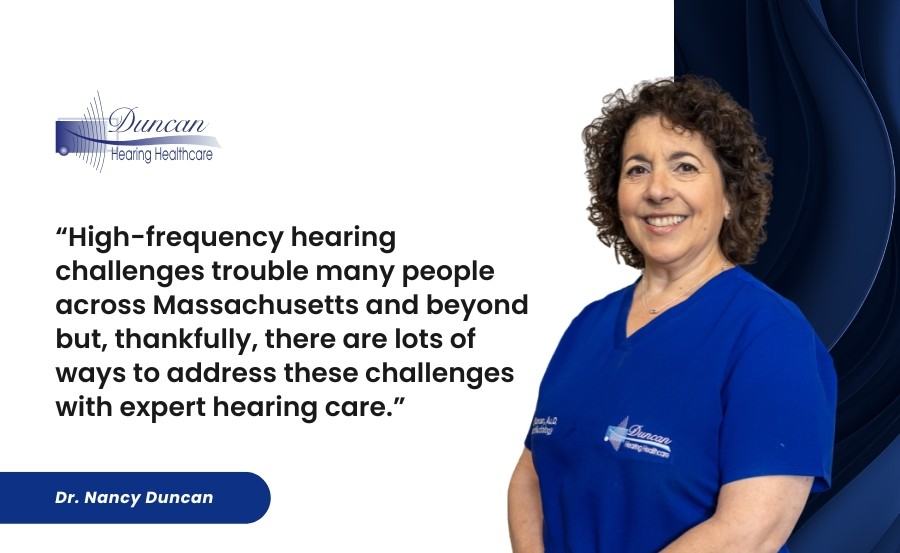
High-frequency hearing challenges trouble many people across Massachusetts and beyond but, thankfully, there are lots of ways to address these challenges with expert hearing care.
The Science of Sound: Why High Frequencies Fade First
Your inner ear is a marvel of biological engineering. Within the cochlea, a spiral-shaped organ, you possess thousands of tiny hair cells (cilia) that translate sound waves into electrical signals your brain can interpret as voices, music, birdsong, and more.
The hair cells responsible for high-pitched sounds are located at the very base of the cochlea. Because these cells are the first to encounter incoming sound waves, they bear the brunt of daily auditory wear and tear.
Over time, these frontline defenders are more susceptible to damage from a variety of causes:
Age-related changes (presbycusis): As you age, the delicate hair cells naturally degrade, especially those handling high frequencies.
Noise exposure: Regular exposure to loud environments, whether from work, concerts, or machinery, can accelerate the loss of high-frequency hearing.
Medications and health conditions: Certain medications, known as ototoxic drugs, and some medical conditions can also impact your hearing health.
As a result, you may find that the higher-pitched elements of sound are the first to diminish, even as other aspects of your hearing remain intact.
The Consonant Connection: Why You Hear but Don’t Understand
Speech is a complex blend of frequencies. Vowels (A, E, I, O, U) occupy the lower frequencies and provide the volume and “body” of speech. Consonants (S, F, Th, Sh, P, K, etc.), on the other hand, are high-frequency sounds that provide clarity and definition.
When you experience high-frequency hearing loss, you still hear the volume of the vowels, but the crispness of the consonants is lost.
This creates a “clarity gap.” Words like “fill” and “hill” or “show” and “throw” can sound nearly identical, making it difficult for you to follow conversations, especially in group settings.
You might find yourself frequently asking others to repeat themselves, not because you weren’t listening, but because your ears are missing crucial pieces of the puzzle.
Navigating Social and Professional Environments
These hearing challenges are often magnified in noisy environments. Restaurants, family gatherings, or meetings can become particularly overwhelming.
This is because separating speech from background noise relies heavily on the brain’s ability to detect those subtle, high-pitched consonants. Since high-frequency hearing loss causes you to miss those consonants, it makes it much harder for you to listen in noisy environments.
The extra effort your brain expends to fill in the missing sounds can leave you feeling mentally drained. This “listening fatigue” is a real phenomenon, and it’s a sign that your brain is working overtime to compensate for your ears.
The impact isn’t just cognitive; it’s emotional and social as well. When you struggle to keep up with conversations, you may find yourself withdrawing from social situations, which can affect your relationships and overall well-being.
You benefit from recognizing these challenges as valid and taking proactive steps to address them. Your hearing health is directly tied to your ability to connect with loved ones and participate fully in life.
Your Path to Clarity: The Diagnostic Process
Seeking a professional hearing evaluation is the first step toward regaining clarity.
During a hearing assessment, your results will be presented on an audiogram: a visual representation of your hearing range across different frequencies.
High-frequency hearing loss typically appears as a “sloping” pattern, where your ability to detect higher pitches drops off compared to lower ones.
Your hearing profile is unique. You benefit from a personalized assessment that goes beyond simple volume measurements, considering your lifestyle, communication needs, and specific challenges.
Modern hearing technology is designed to address high-frequency loss directly, amplifying the sounds you struggle to hear without distorting the ones you still perceive well.
The Benefits of Early Intervention
Addressing hearing loss early provides you with significant advantages. By keeping your auditory cortex stimulated, you protect your brain’s ability to process sound and language.
Rest assured that early intervention helps prevent the social withdrawal, frustration, and cognitive decline that often accompany untreated hearing impairment.
Proactive care empowers you to remain the leader of your own health journey. By seeking help now, you invest in your quality of life, maintaining your independence, confidence, and connections with those who matter most.
Prioritizing Your Hearing Health
Fading voices and muffled conversations are not just minor annoyances; they are important signals from your body that deserve professional attention.
By prioritizing your hearing, you ensure that you remain engaged, empowered, and fully present in every moment.
Ready to regain clarity and reconnect with the world around you? Book your professional hearing evaluation with Duncan Hearing Healthcare today and take the first step toward better hearing health!
FAQ: High-Frequency Hearing Loss
Q: Why do I struggle to hear women’s and children’s voices more than men’s?
A: High-frequency hearing loss affects your ability to detect sounds in the upper frequency range.
Women’s and children’s voices naturally fall into this category, making them among the first to become difficult to understand. This is not a reflection of your attention or effort, but a direct result of changes within your inner ear.
Q: Can high-frequency hearing loss be reversed, or am I destined to lose more hearing over time?
A: While damage to the hair cells in your cochlea cannot be reversed once it occurs, you benefit from early intervention and modern hearing solutions.
Hearing aids and assistive devices are specifically designed to amplify high-frequency sounds, restoring clarity and helping you maintain your current level of hearing. Regular hearing evaluations can help monitor your hearing health and catch any changes early.
Q: How does untreated high-frequency hearing loss affect my brain and overall health?
A: Untreated hearing loss increases the cognitive load on your brain, leading to listening fatigue and potential decline in memory and processing speed.
You protect your brain health by addressing hearing loss early, ensuring your auditory cortex remains active and engaged. A proactive approach also reduces your risk of social isolation and supports your emotional well-being.
Source
Healthline: Learn more about high-frequency hearing loss with this comprehensive overview.